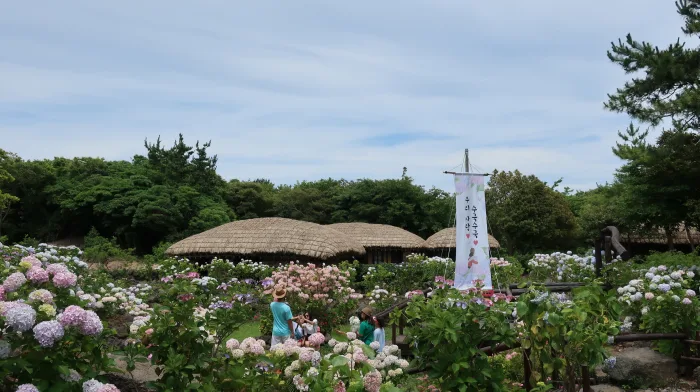
At a Glance: Jeju Folk Village (제주민속촌) offers a glimpse into 19th-century Jeju life with traditional houses, cultural exhibits, and engaging activities.
Expecting to see just a few old houses at Jeju Folk Village (제주민속촌), I was pleasantly surprised by the scale and detail of this cultural facility. More than 100 reconstructed traditional homes immerse you in the daily life of 19th-century Jeju. It’s like walking through time, surrounded by authentic architecture and lush gardens.
What is Jeju Folk Village (제주민속촌) and why does it matter?
Jeju Folk Village is a meticulously recreated living history museum that showcases the customs, architecture, and folk culture of Jeju Island. This venue matters because it preserves the unique heritage of the island, which has distinct traditions compared to mainland Korea. The village allows visitors to understand local lifestyles through its thematic exhibition halls and various cultural experiences.
The site is situated at 631-34 Minsokhaean-ro, Pyoseon-myeon, Seogwipo-si on Jeju-do. It’s open year-round, with varying hours: from October to February, it’s open from 08:30 to 17:00; in March until September, it stays open later until 18:00. Admission fees are ₩15,000 (about $11 USD) for adults and lower for teenagers and children. You might feel differently though.
A walkthrough of the main highlights
Upon entering Jeju Folk Village, you’re greeted by a charming blend of model houses showcasing different aspects of life during the Joseon dynasty. One highlight is the chance to engage in traditional games like Yutnori (a Korean board game) or try your hand at Tuho (arrow throwing). These activities not only provide entertainment but also insight into how leisure was enjoyed in historical contexts.
The village is beautifully landscaped with local flora that ensures something blooms throughout the seasons. I particularly enjoyed the experience programs where you can learn skills such as spinning Maetdol (millstone) or cloth pounding—it’s surprisingly hands-on and fun. Renting an audio guide for ₩2,000 (about $1.50 USD) enhances your visit with context available in English, Japanese, and Chinese. Curious what you think about that.
Is it engaging for non-Korean visitors?
Definitely. While there’s a strong focus on Korean culture here, there’s enough universal appeal to captivate international visitors as well. You might be wondering if language barriers would affect your experience; however, the availability of audio guides helps bridge that gap significantly.
The interactive nature of many exhibits encourages participation rather than passive observation—this is crucial for keeping everyone engaged. But here’s the thing: some parts could benefit from more signage in English since not all descriptions are translated fully.
Nearby attractions to round out your day
If you’re planning a full day around Jeju Folk Village, consider visiting nearby attractions like Seongeup Folk Village or Pyoseon Beach afterwards. Seongeup Folk Village is just a short drive away and showcases additional traditional homes along with beautiful scenery that makes for great photo opportunities.
Pyoseon Beach offers a relaxing spot to unwind after immersing yourself in history; it’s roughly a 15-minute drive from the folk village. And remember, parking at Jeju Folk Village is free—just another practical perk while exploring this area!
Essential Information
| Address | 631-34 Minsokhaean-ro, Pyoseon-myeon, Seogwipo-si, Jeju-do |
|---|---|
| Website | www.jejufolk.com (Korean, English, Japanese, Chinese) |
| Operating Hours | October-February 08:30-17:00 / March 08:30-17:30 / April-September 08:30-18:00 |
| Closed | N/A (Open all year round) |
| Admission / Fee | Individual – Adults 15,000 won / Teenagers 12,000 won / Children 11,000 won Group – Adults 12,000 won / Teenagers 8,000 won / Children 7,000 won 8 Group: 20 or more people |
| Parking | Available |
| Parking Fee | Free |
| Inquiries | +82-507-1457-4502 |
| Map | View on Google Maps |
Additional Details
Life experience – spinning Maetdol (millstone), cloth pounding
Game experience – Yutnori (traditional Korean board game), Tuho (arrow throwing)
Prisoner experience
Audio guide tool available in English, Japanese and Chinese at the ticket office of Jeju Folk Village
* Rental fee: 2,000 won
Frequently Asked Questions
What are the opening hours for Jeju Folk Village?
Jeju Folk Village operates year-round with hours varying by season: October-February from 08:30-17:00; March from 08:30-17:30; April-September from 08:30-18:00.
How much does it cost to enter?
Admission fees are ₩15,000 (about $11 USD) for adults; ₩12,000 (about $9 USD) for teenagers; and ₩11,000 (about $8 USD) for children.
Is there parking available?
Yes, parking is available at no charge at Jeju Folk Village.
Useful Korean Phrases
Tap to expand
Nearby Recommendations
Explore more places within 5km of this location
Nearby Restaurants
- No results found within 5km
Nearby Accommodation
- No results found within 5km
Nearby Attractions
- Lumiverse: Island of Light (빛의 섬 루미버스)5m631-34 Minsokhaean-ro, Pyoseon-myeon, Seogwipo-si, Jeju-do
- Haevichi Hotel & Resort Jeju (해비치 호텔&리조트 제주)146m537, Minsokhaean-ro, Seogwipo-si, Jeju-do
- Pyoseon Haevich Beach (표선 해비치 해변)576mMinsokhaean-ro, Seogwipo-si, Jeju-do